Do you know where all of the dollars associated with your pharmacy benefits are going?
For plan sponsors, understanding how pharmacy benefit dollars move through the system has historically been challenging. Rebates, fees, discounts, affiliate relationships, and other forms of compensation can make it difficult to see the complete financial picture behind a pharmacy benefit arrangement.
New PBM transparency requirements enacted through the Consolidated Appropriations Act, 2026 (CAA 2026) are intended to bring greater transparency to the entire financial picture.
While many of the new requirements directly regulate pharmacy benefit managers (PBMs) and do not become applicable until 2028, plan sponsors and their advisors have an opportunity now to understand what is changing and consider how greater access to PBM financial information may support stronger oversight of pharmacy benefits.
What is changing with PBM transparency?
The CAA 2026 introduces new PBM transparency and disclosure requirements governing PBM arrangements for group health plans, such as specific rebate pass-through requirements applicable to ERISA-covered plans, the new transparency requirement includes provisions related to rebates and other forms of remuneration, disclosures, and audit access.
For applicable PBM contracts or arrangements, the law generally requires PBMs to remit certain rebates, fees, alternative discounts, and other compensation associated with prescription drug utilization or spending back to the plan, subject to some exceptions, including certain bona fide service fees.
The scope extends beyond traditional manufacturer rebates and can include compensation received through other entities within the pharmaceutical supply chain, including rebate aggregators, group purchasing organizations and certain affiliated or subcontracted entities.
If this is 2028, why am I reading about it today?
The requirements generally apply to new, renewed or extended PBM service contracts or arrangements for plan years beginning on or after August 3, 2028. For calendar-year plans, this generally means plan years beginning January 1, 2029.
But the effective date doesn’t define when preparation should begin. PBM arrangements are often negotiated well before a new plan year begins, and contracts being evaluated or renewed before 2028 can influence the access, information, and audit rights a plan has available later.
Upcoming renewal discussions are an opportunity to understand existing arrangements, identify potential limitations, and begin asking questions about how evolving PBM transparency requirements could affect future PBM relationships.
What should plan sponsors consider before their next renewal?
For plan sponsors and their advisors, renewal provides a natural opportunity to look beyond what the plan is spending and consider what the contract allows the plan to see, evaluate, and independently validate.
Questions worth considering include:
- What types of rebates, fees, discounts, and other compensation are associated with the plan?
- How does the PBM define and report those amounts today?
- Does the agreement explain how payments received by PBM affiliates or other third parties are treated and disclosed?
- What information does the plan currently receive to validate PBM performance?
- What audit rights does the existing PBM agreement (and any related amendments) provide?
- Are there limitations on when, how, or by whom an independent audit can be conducted?
- Are there any fees associated with performing an audit of the PBM?
For brokers and consultants, these questions can also help frame more productive renewal conversations with clients by moving beyond cost alone to consider transparency, contract terms, and the ability to independently evaluate PBM performance on a regular basis.
Greater transparency can support stronger oversight.
CAA 2026 also provides new audit rights associated with PBM rebate arrangements.
Receiving additional information from a PBM is only one part of transparency. Being able to independently evaluate that information is another.
Greater visibility into PBM compensation and financial arrangements may help plan fiduciaries evaluate whether service arrangements are reasonable and monitor how plan assets are managed.
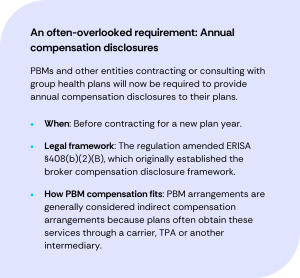
Most notably, and often missed, was the last requirement added to the CAA26 requirements. The regulation amended ERISA §408(b)(2)(B), which originally outlined the broker compensation disclosure requirement framework. In this amendment PBMs, along with many other entities contracting or consulting with group health plans, will now be required to provide annual compensation disclosures to their plans prior to contracting for a new plan year. PBMs more specifically, are primarily considered indirect compensation arrangements due to the nature of obtaining these types of services through a third-party such as a carrier, TPA, or another intermediary administering their plan.
As the regulatory framework continues to develop, plan sponsors and their advisors should monitor new guidance while considering how greater access to PBM information could support their existing or new oversight processes.
Make contract review part of the renewal conversation.
Greater regulatory transparency doesn’t eliminate the importance of the PBM agreement itself.
Contract terms establish the framework for how the relationship operates, including definitions, guarantees, reporting obligations, data access, and audit rights. Reviewing those provisions before initial engagement or renewal can help identify potential limitations while there may still be an opportunity to negotiate and address them.
As PBM requirements evolve, plan sponsors and their advisors may want to review whether existing agreements clearly address:
Audit rights. Does the plan have the ability to independently validate claims, rebates, guarantees, and other aspects of PBM performance?
Data access. Does the agreement provide sufficient access to the information necessary to conduct a meaningful review? And is there a fee to access the information?
Rebate definitions. How are rebates, discounts, fees, and other forms of remuneration defined?
Affiliate relationships. Does the agreement address compensation or services involving PBM affiliates and other related entities?
Financial guarantees. Are PBM pricing and other contractual guarantees clearly defined, measurable, and independently verifiable?
Timing and lookback periods. How long does the plan retain the ability to audit historical performance? 
Transparency increases knowledge. Oversight keeps it accountable.
More PBM data alone doesn’t tell a plan sponsor whether claims were administered correctly or contractual commitments were met.
This is where independent validation plays an important role.
A Pharmacy Claims Audit can evaluate pharmacy claims against plan design and applicable contract terms to help confirm accuracy, identify discrepancies, systemic issues and potential areas of missed value. Depending on the scope, additional reviews can also examine financial guarantees and rebate arrangements.
For plan sponsors, that independent review can provide another layer of documentation supporting ongoing plan oversight and prudent plan management.
And for benefits consultants, it can provide clearer information to bring into client conversations about PBM performance, contract terms, and renewal strategy.
Use the time before 2028 to ask strategic questions.
The new requirements may not take effect immediately, but the contracts, renewal decisions, and oversight practices being put in place today can shape a plan’s ability to access and evaluate information tomorrow.
For plan sponsors, now is an opportunity to understand existing PBM arrangements, review contract terms and audit rights, and identify where greater visibility is needed.
For brokers and consultants, it’s an opportunity to help clients ask more strategic questions about where pharmacy dollars are going, what information is available to validate performance, and whether current agreements provide the proper access needed for meaningful oversight.
Greater transparency provides more insight.
The value comes from using it to your advantage.
See what’s happening behind your pharmacy spend.
Lumelight provides independent Pharmacy Claims Audits designed to help plan sponsors and their advisors evaluate claims accuracy, PBM performance, and contract compliance.
Learn more about Pharmacy Claims Audits →
*This article draws on regulatory analysis originally published by ClearFile, a Lumelight company specializing in regulatory compliance management.